The New England Patriots Steal A.J. Brown in Underwhelming Trade Package
The Philadelphia Eagles have officially traded wide receiver A.J. Brown to the New England Patriots in exchange for a 2027 fifth-round pick and a 2028 first-round pick.
From a pure value insulation standpoint, this is a massive win for New England's front office. Getting an elite X-receiver without surrendering a first-round pick in the loaded 2027 class is surgical asset management. The Patriots held the leverage, weaponized Philly’s internal friction, and walked away with a championship-altering piece.
Before we dive into the article, I have a massive update for those looking to dominate their leagues. My 2026 Rookie Guide is dropping soon. This comprehensive manual will feature over 60 rookies and cover the optimal strategy for positions 1-12 in your drafts.
Want an exclusive 50% discount? Subscribe to The Architect’s War Room. It is completely free, and by joining, you get my public articles delivered straight to your inbox, along with exclusive access to the public channels in my Discord. Don't leave your draft to chance, get the intel that wins championships.
The Patriots Get Their True X
For a team that fell just short of holding the title up high last season, the wide receiver room was a glaring vulnerability. While Stefon Diggs brought pristine route running, he is structurally a Z-receiver who lacks the sheer mass and catch-radius to consistently anchor the backside of the formation as a true X. Shifting Diggs to a Z-alignment would have optimized his role perfectly, making the front office's decision to let him walk entirely without a standard draft replacement, a move that leaves a massive vacuum in this offense. Despite any off-the-field noise, his purely mechanical value to a passing game remains elite. He was simply too valuable to lose without a clear contingency plan.
To understand just how much efficiency New England is tasking their new weapons to replace, you have to look at the numbers. Diggs was managed on a deliberate snap count last season, yet his underlying metrics remained among the absolute elite in the league. Over the 2025 regular season, he turned his 102 targets (ranking 26th at the position) into 85 receptions, landing him 9th overall among qualified receivers. He easily crossed the thousand-yard threshold with 1,013 receiving yards, a mark good for 15th in the NFL.
Where his true, irreplaceable value shines through is in his efficiency and grading. Diggs posted a staggering 2.74 Yards Per Route Run (YPRR), making him the 5th most efficient receiver in the entire league on a per-route basis among 81 qualifiers. This pristine route architecture and high-level separation earned him an 87.5 overall Pro Football Focus (PFF) grade, placing him 6th overall at the position. His 85% catch rate acted as the ultimate safety net for this offense, proving that even with limited snaps, he was a foundational engine that dragged this team to the brink of a championship.
Now enters A.J. Brown, who stands as the quintessential alpha X. His arrival completely rewrites the geometry of this entire passing game. First, his massive coverage gravity dictates that opposing safeties bracket his side of the field, which naturally stretches defensive shells and opens up the intermediate middle of the field. Second, his presence unlocks invaluable versatility across the formation. Had Diggs remained, Brown's presence would have allowed him to slide into his natural Z/slot hybrid role where he could feast against single coverage and sub-package defensive backs. Without Diggs, Brown now bears the burden of being the singular focal point, forcing the remaining youth on the roster to rapidly step into the spaces he creates.
The Price of Friction in Philly
As Nick Saban famously noted, individual frustration can easily disrupt an entire team ecosystem. When a superstar player feels underutilized, it creates a ripple effect that touches everything from locker room chemistry to play-calling rhythm. In Philadelphia, A.J. Brown's open discontent with his role and usage wasn't just standard social media noise; it was the outward symptom of a deep structural fault line within the organization.
While critics will point to a few high-profile drops as a justification for altered looks, the reality of modern football is simple: an elite passing game must consistently feed its primary engines. Behind Saquon Barkley, Brown was undeniably the engine of that entire aerial attack. He is an explosive, high-volume playmaker who dictates how defenses align. When a coaching staff fails to consistently manufacture touches for its most dominant weapon, friction becomes entirely inevitable.
The breakdown happens when a player of Brown's caliber is relegated to a decoy or a secondary thought on critical downs. It forces a toxic cycle. The quarterback starts forcing passes to appease the star, the offensive coordinator becomes reactive rather than proactive, and the defense begins to cheat because the offense's internal tension makes them predictable.
Winning a championship usually masks these issues temporarily, but victory is only a temporary band-aid on a structural tear. Once the confetti settles, the underlying business and personal realities remain. By failing to balance the distribution of the ball between a dominant ground game and a premier X-receiver, the Eagles' leadership painted themselves into a corner. They lost the leverage, alienated their top receiver, and were ultimately forced to sell an elite asset in his prime for a return package that fell well short of his true on-field value.
Dynasty & Betting Market Outlook
New England's window is wide open. While the Los Angeles Rams remain the clear front-runners in the market, New England just secured the specific piece required for a deep playoff push and a legitimate Lombardi window over the next two years.
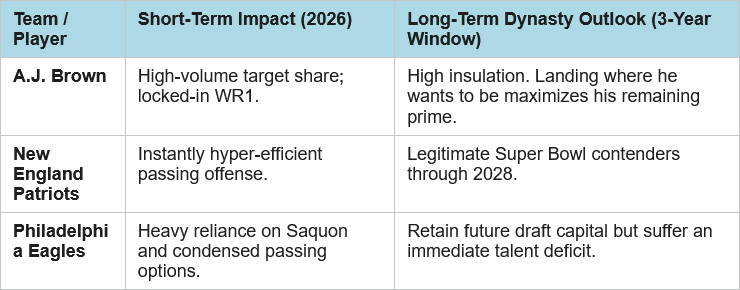
Expect Brown to operate with a chip on his shoulder this season, stepping into a scheme that desperately needs his specific skill set. The Patriots just won the offseason.